

An executive desk is a large-format, storage-forward desk designed for private offices and leadership roles where workspace, professionalism, and organization must work together. At Office Furniture Solutions Florida, we help executives and business owners pin down the right desk for their office and their actual workflow.
Typically sized between 60 and 84 inches wide and 30 to 42 inches deep, an executive desk delivers the generous surface area, integrated storage, and premium materials that standard office desks aren’t designed to handle.
What Is an Executive Desk?
An executive desk is a purpose-built workstation for daily use in private or leadership-facing environments. It trades compact efficiency for surface area, storage depth, and the kind of visual authority that a standard desk just doesn’t project.
Core definition
Executive desks typically range from 72 to 86 inches wide, include drawers and cabinets for document organization, and are finished on all sides because they serve as the focal point of the room rather than being placed against a wall. Most come with a modesty panel to keep things professional when clients are seated across from you.
Typical settings
Private offices, law firms, corporate leadership suites, and home office setups where the desk anchors the room. Anywhere the desk needs to carry multiple projects, hold its own visually, and leave a lasting impression on clients walking through the door.
Executive Desk vs. Standard Desk
These two categories are not interchangeable. The gap in size, storage, and design shows up in daily operations and in how the entire office reads to anyone who walks in.
Size and workspace
Standard office desks run 60 to 72 inches wide, built for compact efficiency and screen-focused work. Executive desks range from 72 to 84 inches, providing ample workspace for documents, multiple monitors, and face-to-face client meetings without anything feeling cramped.
Storage and privacy
Standard desks typically have one or two drawers. Executive desks offer deep drawers, pedestal cabinets, and locking compartments for sensitive documents. The modesty panel adds a layer of visual privacy that standard desks lack.
Design impact
A standard desk sits in the background. An executive desk is in the room. It creates a sense of authority and leadership from the moment someone walks in, projecting professionalism that regular desks can’t match.
Types of Executive Desks
Each configuration solves a different problem. Choosing between them comes down to room size, how you work, and what your technology setup demands.
Traditional executive desks
Ornate solid wood designs, rich finishes, carved edges, quality hardware. A traditional executive desk signals permanence and authority in a way that modern alternatives don’t replicate. Ideal for anyone who wants a classic, unmistakably professional look.
L-shaped executive desks
An L-shaped executive desk features a perpendicular return, creating two distinct work zones in a single footprint. It tucks into corner space cleanly, keeps screen work separate from documents or meetings, and suits executives juggling multiple projects without needing the full wraparound of a U-shape.
U-shaped executive desks
A U-shaped executive desk combines a primary surface, a bridge, and a credenza return. Maximum workspace, maximum storage options, everything within arm’s reach. It’s the preferred setup for executives running complex, high-volume workloads, though it does require a room that can take it.
Standing executive desks
Executive-scale surface area and integrated storage, with height adjustability built in for sitting and standing positions throughout the day. Pair one with ergonomic accessories and an adjustable-height office desk configuration to stay comfortable throughout a full workday.
Features to Look for When Buying an Executive Desk
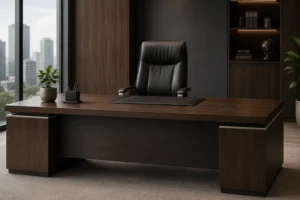
A desk that looks right in the showroom needs to perform over the years of daily use. These features determine whether it actually will.
Desk size and layout
Measure the office first. Always. Confirm the desk footprint leaves clearance behind the chair and on every side. A desk that crowds the room creates circulation problems that no amount of quality can overcome.
Storage options
Drawers, cabinets, and locking compartments for sensitive documents. Built-in storage keeps the surface clear, eliminates the need for separate filing furniture, and maintains the organized workspace that leadership roles demand.
Surface materials
Superior materials like solid wood or quality metal frames outlast regular desks built from engineered wood and laminates. And they hold their polished finishes through years of daily use in a way that cheaper surfaces don’t.
Power and cable management
Multiple monitors mean multiple cords. Built-in grommets and concealed cable management trays keep the desktop clean from day one. Modern executive desk options go further with wireless charging, hidden cable routing, and pop-up power outlets integrated directly into the surface.
Ergonomic compatibility
Check that the desk height works with your chair before buying. A desk that puts you in the wrong sitting position causes strain regardless of how much it costs. If you alternate between sitting and standing, confirm the configuration supports ergonomic accessories or an adjustable setup.
Factors That Affect Executive Desk Cost
A few factors determine the cost of an executive desk.
Material quality
Solid wood and quality metal frames cost more upfront. But they outlast laminates by years and don’t need refinishing or early replacement. The math tends to work out.
Desk configuration
L-shaped and U-shaped executive desks carry a higher price tag than single-surface models. More components, more materials. Storage-heavy configurations with deep pedestals and locking cabinets push prices even higher.
Delivery and installation
Large executive desks need professional assembly. Factor that into the total cost comparison, especially for U-shaped configurations with multiple components that have to be fitted together on-site.
How to Choose an Executive Desk for Your Office
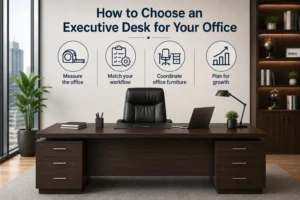
Follow these tips to pick the right executive desk for your workspace.
Measure the office
Room dimensions and desk footprint before anything else. Measure with the chair pulled out and the doors fully open. Small oversights at this stage create big problems after delivery.
Match your workflow
Work habits determine configuration. Heavy paperwork and client meetings favor a single-surface desk with deep storage. Multi-screen setups favor L- or U-shaped layouts. Regular sitting and standing favor a standing desk with an executive-grade surface area.
Coordinate office furniture
Match desk finish and materials to the rest of the room so the entire office reads as one coherent space. An office furniture store with experience in layout planning avoids the common mistake of buying a desk that works in isolation but clashes with everything around it.
Plan for growth
Pick a desk that supports the role you’re in and the one you’re moving toward. An executive office desk with modular storage options keeps you flexible as your workload grows.
Executive Desk Mistakes to Avoid
Don’t commit these mistakes while buying executive desks.
Oversizing the room
A desk filling more than a third of the office space feels oppressive, not authoritative. Scale the desk to the room.
Ignoring power access
No integrated power access means a cable management problem the moment setup is done. Test the desk’s power and routing options before purchasing, not after it’s been assembled in your office.
Choosing style only
An executive desk that looks impressive but lacks functional storage, proper cable management, or ergonomic compatibility will fail its user every single day. An office table with fewer features may serve certain roles better than an oversized executive piece bought purely for aesthetics.
When an Executive Desk Is Worth It
An executive desk is worth buying in these scenarios.
Private offices
Where the desk is the room’s centerpiece, an executive desk pays for itself through daily function, storage capacity, and the professional impression it makes on everyone who enters.
Client-facing roles
If you meet clients at your desk, the furniture communicates before you do. A standard desk in that setting signals a mismatch between role and environment that clients pick up on immediately.
Storage-heavy work
Roles managing high document volume, confidential files, or multi-project workflows need built-in storage and an organized workspace. Standard desks leave those users patching the gap with external filing solutions that clutter the office. Office Furniture Solutions Florida provides office furniture in Miami for individual executives and complete office buildouts. Ready to find the right executive desk for your space? Our team can help you get there.
Executive Desk FAQs
Let’s answer some common queries regarding executive desks.