

The right desk shapes how a workspace functions. At Office Solutions of Florida, we work with businesses across South Florida (and across the US) that need office desks suited to real roles and real rooms. Whether you’re furnishing a corporate office or a communal office space for a growing team, the types of office desks available today cover every combination of size, storage, and workflow. This guide covers each type so you can choose the right desk with confidence.
What Is an Office Desk?
An office desk is a workstation designed for focused work, equipment support, and organized storage. Modern office desks vary by layout, user role, and technology needs, covering everything from a minimal flat surface to a wraparound U-shaped desk with built-in storage on all sides.
Desk vs. workstation
A desk is a single freestanding piece. A workstation desk typically includes a desk, shelving unit, privacy panels, and cable management components purchased as a coordinated system.
Desk vs. table
A table offers a flat surface without productivity-focused features. A desk is purpose-built for work, with drawer storage, cable routing, and desktop space for computer screens and office supplies.
Common Types of Office Desks
The most widely used office desks each serve a distinct purpose. Matching the desk to the role prevents clutter, poor posture, and inefficient layouts.
Writing desks
They have a flat surface for handwriting tasks with drawer storage for writing tools and office stationery. They suit roles needing more writing space without equipment clutter.
Computer desks
They are built around screen setups, with built-in cable holes that keep desktop space organized.
Executive desks
They are broad, heavy-storage pieces built for extensive paperwork in a corporate office. An executive office desk pairs ample storage with a professional aesthetic.
L-shaped desks
They consist of two perpendicular surfaces that wrap around the corner, separating a computer setup from a dedicated writing space. For tight spaces, L-shaped desks are the most versatile option.
U-shaped desks
They combine a desk, a bridge, and a credenza for a wraparound workspace with significant storage, preferred by executives managing complex workloads.
Corner desks
They fit directly into corner spaces, maximizing efficiency while providing ample workspace for documents and office supplies.
Standing desks
They allow users to work vertically at adjustable heights, alleviating lower back pain and maintaining energy levels throughout the workday.
Adjustable height office desks
They function as both sitting and standing desks. An adjustable-height office desk lets users shift positions throughout the day for long-term ergonomic benefits.
Office Desk Types for Teams and Shared Workspaces
Team environments need desks that balance collaboration, privacy, and space efficiency in a shared office setting.
- Bench system desks provide an extra-long desk that accommodates multiple desktops and chairs, ideal for teams that work closely together in an open-plan, communal office space.
- Cubicle workstations add privacy panels to reduce distractions without fully isolating employees.
- Modular desks reconfigure as teams grow, offering flexibility for offices that anticipate layout changes.
- Hot desks are unassigned, and rotating desks are common in hybrid desk arrangements where staff split time between home and office.
Office Desk Types for Specialized Areas
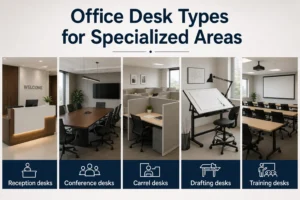
Specialized spaces require furniture configured for their specific function, not standard employee workstations.
- Reception desks shape the first impression for office guests and support front-of-house tasks.
- Conference desks provide a large shared surface. A circular desk or dual-sided desk version promotes direct communication and collaboration.
- Carrel desks offer a private space with a three-sided enclosure, ideal for work that requires separation from shared areas.
- Drafting desks feature an angled surface for technical drawing or design work.
- Training desks are lightweight and reconfigurable for rooms that shift between classroom and collaborative layouts.
Materials and Finishes for Office Desks
Desk material affects durability, appearance, and budget.
- Laminate desks are affordable and scratch-resistant, the practical choice for high-use environments.
- Wood veneer desks deliver the look of wooden desks at a lower cost by applying a real wood layer over a composite core.
- Solid wood desks offer the highest durability. A wood desk built from solid wood carries weight in executive and boardroom settings.
- Metal desks are durable and easy to clean, making them suited to industrial or contemporary office designs.
- Glass desks create a visually open feel but require more maintenance and are better suited to private offices than to high-traffic areas.
Features to Look for When Choosing an Office Desk
These features determine whether a desk supports or disrupts daily work. Before purchasing office desks, evaluate:
- Storage options: Pedestal desks, credenza configurations, and a shelving or cabinet unit keep documents organized without consuming desktop space.
- Cable management: Built-in routing holes and trays keep computer screens and peripherals tidy from day one.
- Ergonomic fit: Desk height aligned with elbow height reduces shoulder and neck strain across a full ergonomic workspace.
- Surface size: Match ample workspace to actual task volume, not just available floor space.
- Power access: Integrated ports and grommets for computer stands eliminate the need for extension cords.
- Privacy panels: Add-on panels create a dedicated space in open-plan offices without full cubicle infrastructure.
How to Choose the Right Office Desk
Five questions, answered before you browse, will identify the perfect desk for any role.
- Measure the space: Know room dimensions and the desk’s footprint. An L-shaped desk that fits one room may block circulation in another.
- Define the workflow: A secretary desk with a pull-down shelf is suited to paperwork-heavy roles. A multi-functional desk with ample space suits roles that mix tasks.
- Plan for storage: Pedestal desks and desks with built-in storage solve different problems. Match storage type to the volume and format of materials used daily.
- Consider technology: Count computer screens and computer stands before choosing. Confirm that cable management and power access are adequate for the setup.
- Match the office style: Desk finishes should coordinate with existing office furniture. Mismatched pieces create a disorganized look, regardless of the quality of individual desks.
Office Desk Mistakes to Avoid
Common purchasing mistakes create clutter, discomfort, or inefficient layouts.
- Buying too large: A desk that dominates the office space limits movement and feels cramped. Measure first.
- Ignoring ergonomics: The wrong desk height causes strain within weeks. An ergonomic workspace starts with the desk.
- Overlooking storage: No ample storage means filing units appear as workarounds, cluttering the organized workspace.
- Forgetting cables: No cable management turns a clean desktop space into a tangle of cords at first setup.
- Mismatching furniture: Pairing glass desks with wooden desks, or metal desks with warm laminate, reflects poorly on a corporate office environment.
Why Work With an Office Furniture Provider
Getting desk selection right across an entire office is harder than choosing one desk for one person. Office Solutions of Florida provides space planning support and coordinated furniture solutions across layout, workflow, and budget.
Space planning support
An office furniture store with planning expertise maps desk placement, traffic flow, and storage zones against your actual floor plan before you commit to a purchase.
Coordinated furniture solutions
Desks, chairs, panels, and reception furniture work better when sourced together. Office Solutions of Florida provides office furniture in Miami across all categories, so businesses can furnish complete spaces without juggling multiple vendors.
FAQ About Types of Office Desks
Here are some questions answered about types of office desks.